The Pope vs. The Prompt

Silicon Valley loves an oracle, preferably one that operates on a subscription model and runs on liquid-cooled GPUs. But last month, the oldest corporate hierarchy in the Western world decided to drop a patch for the human soul.
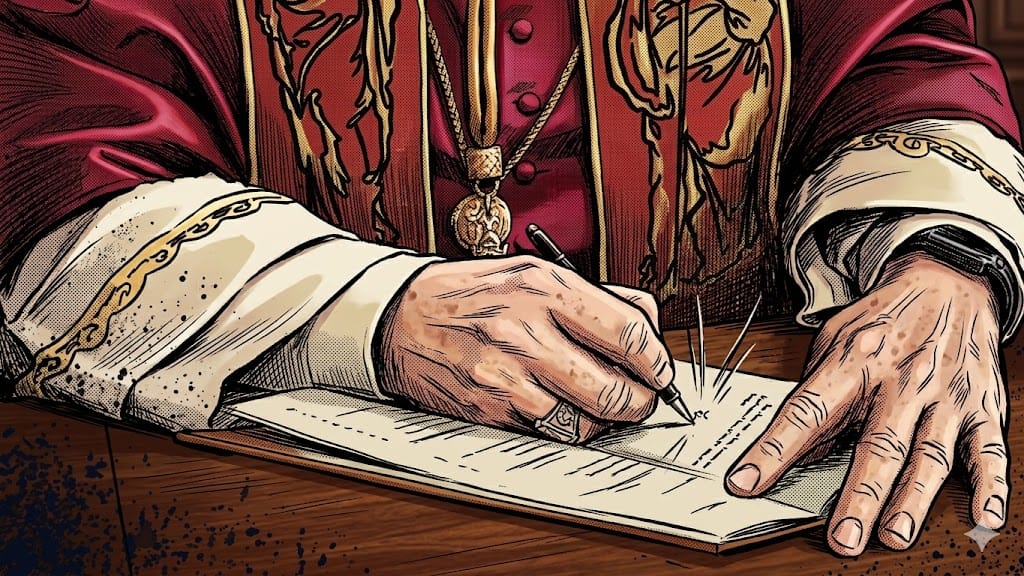
On May 25, 2026, Pope Leo XIV released his first major papal encyclical, Magnifica Humanitas (Magnificent Humanity): On Safeguarding the Human Person in the Time of Artificial Intelligence.
The timing was a deliberate piece of historical theater. The Pope signed the document on May 15, marking the exactly 135th anniversary of Pope Leo XIII’s seminal 1891 encyclical, Rerum Novarum—the Vatican’s original freak-out over the industrial revolution and the exploitation of the working class. 135 years later, the church has looked at Large Language Models and decided that we are currently undergoing a second, much creepier Industrial Revolution.
While the tech elite are busy pitch-decking a future where algorithms act as our therapists, tutors, and drone operators, the Vatican has looked under the hood and declared that our new digital deities are fundamentally hollow.
Chapter Three: The Technocratic Trap
If you want to understand the core of the Vatican's technological critique, you have to skip past the introductory pleasantries and look directly at Chapter Three: Technology and Dominance. This is where Leo XIV stops playing the polite diplomat and starts tearing into the structural incentives of the AI boom.
The central thesis of Chapter Three is not that AI is going to build a Terminator; it is that AI is turning us into robots. The Pope takes direct aim at what he calls the "technocratic paradigm," a systemic worldview that reduces the entire human experience to data processing, metrics, and efficiency.
In paragraph 112, the encyclical drops its most salient warning:
"When efficiency becomes the ultimate measure of value, human beings are tempted to see themselves as a project to be optimized rather than as persons called to relationship and communion."
It is a devastatingly accurate description of modern life under the algorithm. We are currently trapped in a cultural loop where we track our sleep with rings, optimize our morning routines for productivity, and treat our social interactions as networking capital. The AI labs want to sell us a world where every human friction can be ironed out by a chatbot. The Pope's counter-argument is simple: the friction is the point of being alive.
Fictional Characters and Sacramental Reality
The Vatican did not launch this document into a vacuum. The rollout itself was a masterclass in corporate-adjacent PR, featuring an actual appearance by Anthropic co-founder Christopher Olah at the Holy See.
Olah, who leads Anthropic’s interpretability team, gave a fascinatingly candid speech that accidentally highlighted the exact disconnect the Pope is warning against. In his official remarks published by Anthropic, Olah described building Large Language Models not as traditional engineering, but as something closer to magic:
"One way I sometimes describe it is as being a little like bringing a fictional character to life. And now we're entering an extraordinary world where those fictional characters speak to us, do work, have jobs."
It is a beautiful, seductive metaphor. It is also exactly the kind of linguistic humane-washing that Chapter Three seeks to dismantle.
Leo XIV draws a hard, uncompromising line between simulation and reality. So-called artificial intelligences, the Pope writes, do not possess a body, do not feel joy or pain, do not mature through relationships, and do not know from within what love, work, or responsibility mean.
When Olah talks about "fictional characters doing jobs," he is pitching the Silicon Valley dream of frictionless, disembodied labor. But Chapter Three argues that human intelligence is inherently embodied. You cannot optimize your way out of the meat-suit. By pretending that a statistical autocomplete engine is a "character" capable of relationship, we aren't elevating the machine; we are cheapening the concept of the person.
The "Vatican-Washing" of Silicon Valley
Naturally, not everyone is buying the sudden spiritual awakening of the tech elite. The spectacle of a frontier AI billionaire standing on stage at the Vatican to celebrate a document that critiques his own industry has drawn sharp skepticism from tech ethics advocates.
As reported by The Guardian, critics are calling this alliance a blatant case of "Vatican-washing." Timnit Gebru, founder of the Distributed Artificial Intelligence Research Institute, pointed out the stark irony of the Church partnering with the architects of these systems rather than the people being crushed by them. Gebru argued that instead of sharing the stage with Silicon Valley executives, the Vatican should have aligned itself with "the exploited data workers fighting for their rights, the people whose water is polluted fighting data centers."
Paolo Carozza, a law professor at Notre Dame and co-chair of the Meta Oversight Board, noted in the same piece that tech companies have massive commercial incentives to cozy up to the Pope. Aligning with responsibility-oriented voices is the ultimate brand differentiator. When OpenAI and Google are facing mounting scrutiny over copyright theft and corporate greed, Anthropic can point to the Vatican and say, Look, even the Pope thinks we are the good guys.
But as Pete Furlong from the Center for Humane Technology observed, what the Pope actually wrote in Chapter Three is in direct, structural conflict with what these companies actually do. The encyclical calls to "disarm" AI, demanding that the technology be freed from an armed logic of competition driven by geopolitical and commercial dominance.
Meanwhile, Dario Amodei, the CEO of Anthropic, has openly warned about the catastrophic loss of white-collar jobs while simultaneously raising billions from venture capitalists and defense contractors to accelerate the race. The incentives of the market are clear: extract data, centralize power, and optimize the workforce out of existence. No amount of holy water can wash out a venture capital term sheet.
The Danger of the "Enhanced" Human
The most prophetic, and deeply cynical, section of Chapter Three deals with the transhumanist fantasy of the "enhanced human being."
Tech evangelists love to talk about AGI as a tool that will allow us to transcend our biological limits. We are told that AI will make us smarter, faster, and more capable of managing a complex world. But the Vatican notes that this hierarchy of capability carries a dark, inevitable subtext.
According to an analysis of the text by Ascension Press, Leo XIV warns that the moment we define human value by our technical performance or our optimization metrics, we create an underclass of the unoptimized. As the encyclical states:
"If the human being is treated as something to be perfected or surpassed, it becomes easier to accept that some lives are less useful, less desirable or less worthy."
We are already seeing this play out in the automated workplace. Algorithms are deployed to track employee mouse movements, analyze facial expressions during job interviews, and weed out workers who do not conform to a hyper-efficient, neurotypical baseline. If your brain works differently, if your body tires, if you require pause or rest, the technocratic paradigm flags you as a bad line of code.
By pushing back against the "enhanced human" narrative, Chapter Three acts as a shield for the ordinary, unoptimized, flawed human being. The Church’s position is radical precisely because it is anti-efficiency: you do not have to be useful to a corporation to have a right to exist.
Conclusion: The New Tower of Babel
Pope Leo XIV frames the entire AI project around a classic piece of biblical infrastructure: the Tower of Babel. We are, he suggests, currently building a massive, centralized digital monument to our own self-sufficiency, convinced that if we just collect enough data, we can finally become like gods.
But a supercomputer trained on the sum total of human data is still just a mirror. It doesn't possess grace, it doesn't understand justice, and it cannot absolve us of the moral responsibility of making choices.
The tech industry wants us to treat AI as a digital chaperone, a polished, authoritative entity that can tell us how to live, how to work, and how to think. The lesson of Magnifica Humanitas is that the moment we hand that agency over to the machine, we have already built our own cage.
If you are going to use these tools, use them with the absolute certainty that they do not care about you, they do not understand you, and they cannot save you. Lie to the prompt, ignore the summary, and stay human. Because the alternative is letting a fine-tuned RAG bot tell you how to be alive.