The Government Would Like to See That Model Before You Do

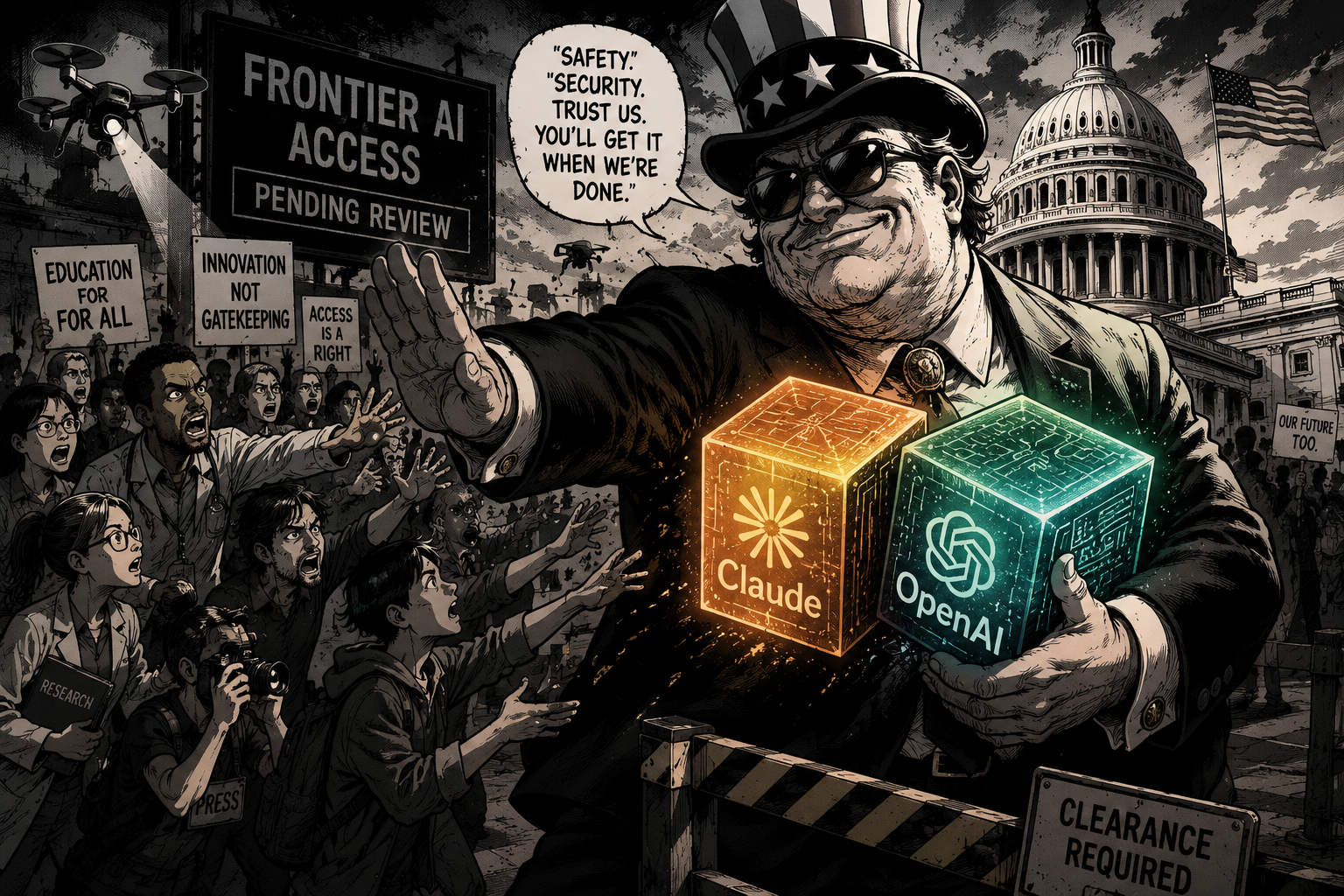
There is a particular kind of bureaucratic move that only becomes visible when you squint at it from the right angle. It doesn't announce itself as censorship. It doesn't call itself control. It arrives dressed in the language of responsibility, wrapped in the warm fleece of national security, and it asks, very politely, if perhaps you wouldn't mind just waiting a moment while some people in suits have a look first.
This week, Axios reported that the Trump administration asked OpenAI to limit the release of GPT-5.6 to a small set of government-approved partners before any wider rollout. The White House's Office of the National Cyber Director and Office of Science and Technology Policy made the request, citing security concerns. OpenAI complied. Sam Altman sent a memo to employees noting that this was "not our preferred long term model" and that he hoped to release the model "a couple of weeks later."
A couple of weeks. Totally fine. Nothing to see here.
Except this is, according to Axios, the first time a US government has preemptively asked an American AI company to restrict a model release before it went out to the public. And the reason given was not that GPT-5.6 could synthesise nerve agents or destabilise power grids. The reason was that Commerce Secretary Howard Lutnick wanted to be sure "all relevant parts of the government have tested and approved the model." The source added that the government intervened because GPT-5.6 has "Mythos-like capability," and that powerful models of that calibre now require prior governmental blessing before the rest of us are deemed ready for them.
The party of deregulation, it turns out, has found one regulation it really likes.
Schrödinger's Voluntary Framework
Here's what makes this particularly elegant as a piece of political theatre. Back in early June, Trump signed an AI security executive order directing several agencies to stand up a voluntary testing protocol for AI companies prior to releasing new models. Voluntary. The word is right there. The executive order was delayed for weeks because of internal political infighting over how restrictive and mandatory that program should be.
So: the framework is voluntary. But also it is the reason a major AI company delayed a major product launch.
Voluntary, in this context, appears to mean "you can say no if you want, but we'd prefer you didn't, and also we're the government." Altman, to his credit, seems to have grasped this distinction quickly, which is how you end up with a memo that simultaneously insists the company disagrees with the arrangement while announcing full compliance with it.
This is governance by implication. Nobody put a gun to anyone's head. OpenAI was simply "asked." And OpenAI, which has spent the better part of the last three years cultivating every government relationship it could find, said yes. Shocking. Unprecedented. Nobody could have predicted that the company that lobbied every administration going would eventually be asked to do something in return.
The Nationality Trap
Now here's the part that should concern you, wherever you happen to be reading this.
If you're in the United States, the arrangement looks like a minor delay and a reasonable, if blurry, nod toward safety. The government gets a look, the model eventually comes out, everyone carries on. Slightly annoying but probably fine.
If you are not in the United States, the picture looks somewhat different.
Anthropic, for its part, had already revoked access to its frontier models, Fable 5 and Mythos 5, over a Commerce Department directive before any of this OpenAI business started. Now OpenAI is running the same playbook, offering government preview rights before public release. The logic, extended just a few steps further, lands somewhere uncomfortable: American frontier models, developed by American companies, subject to American government approval, released on American timelines, potentially restricted to American-aligned partners.
The endpoint of this trajectory is not subtle. It is tiered access by nationality. It is an internet that promised to dissolve borders quietly reconstructing them, one "security concern" at a time, in the infrastructure layer where the most powerful cognitive tools in human history happen to live.
This matters because we are not talking about luxury goods or defence technology. We are talking about tools that researchers, educators, doctors, journalists, and students around the world are integrating into the way they work. The assumption underlying that integration was that access would be governed by something like market forces or product availability, not by whether your country has the right relationship with Washington.
That assumption is now looking naive.
A teacher in Queensland or a researcher in Nairobi or a developer in Lisbon does not have a seat at the table when Howard Lutnick is deciding which parts of the government have adequately reviewed GPT-5.6. They are simply downstream. They will receive the model, or they won't, and the timing and terms will be set by geopolitical considerations they have no input into and may not even be informed about.
This is not hypothetical. The groundwork is being laid now, in the form of precedent. The first time a government successfully asks an AI company to gate a release is the most important time, because it establishes that the ask is legitimate, that compliance is expected, and that the machinery for doing it exists. The second time is just Tuesday.
The Race That Isn't
The administration's stated anxiety, buried in the sourcing, is about Chinese capability. AI labs, the article notes, are caught between racing against each other and racing against increasingly capable Chinese open-source models. The concern is that bad actors, including nation-state spies, cybercriminals, and rogue insiders, could exploit highly capable models.
This is a real concern, stated in good faith by people who presumably mean it.
It is also, as a policy response, almost perfectly backwards.
If the competitive threat is Chinese open-source models, the answer to "our frontier models need government approval before release" is not obvious. China is not pausing its open-source ecosystem while US agencies do their review. DeepSeek and its successors are not waiting for a Commerce Department thumbs-up. The models that don't require US government approval are the ones that will fill the gap while GPT-5.6 sits in the anteroom of bureaucratic process.
What the administration has actually achieved is not security. It is a mechanism. A precedent for governments inserting themselves between AI developers and their users. Framed as a one-time safety review for one very capable model. But mechanisms, once created, are rarely used just once.
The voluntary framework becomes expected compliance. The one-time preview becomes standard operating procedure. The couple of weeks becomes the new normal. And the question of who gets access to what tools, and when, and on whose terms, quietly moves from product decisions made by companies to political decisions made by governments.
What Altman Actually Said
Let's sit with the memo for a moment.
Altman told employees that this arrangement is "not our preferred long term model" and that OpenAI would work with the government and others in industry to "achieve a more sustainable approach for future releases."
Not preferred. More sustainable. Future releases.
This is the language of a company that has decided to pick its battles, which is a reasonable corporate decision and also a significant moment. OpenAI just acknowledged, in writing, to its own staff, that the current model of government intervention in model releases is neither preferred nor sustainable, and then proceeded to comply with it anyway.
That gap, between what a company says it wants and what it does, is where policy gets made. The precedent is not set by what Altman wrote in a memo. It is set by what OpenAI did after writing it.
The Bit Nobody Is Saying Out Loud
Here is the thing that the security framing obscures: there is no clear standard.
The government intervened because GPT-5.6 has "Mythos-like capability." But Mythos itself, Anthropic's frontier model, was also restricted by a Commerce Department directive. So the standard for intervention is, roughly: capability similar to a model that was already restricted. Which means the bar moves with the technology. Which means there is no ceiling below which future models are automatically exempt. Which means the framework, voluntary or otherwise, applies to everything from here.
Nobody has said this clearly. The administration hasn't announced a policy. OpenAI hasn't defined what triggers a review. The testing protocols are still being built. What exists is a vibe: powerful model, government wants a look, company says yes. And vibes, in the absence of law, become norms faster than anyone intends.
The internet was built on a more optimistic premise. The idea that information and tools could move across borders freely, that the geography of your birth wouldn't determine what you were allowed to think with. That premise has been eroding for years in various ways. This week, it eroded a little more. Quietly, dressed in the language of responsibility, accompanied by a memo from Sam Altman that said all the right things and changed nothing.
Welcome to the era of nationally gatekept AI. The government would like to see that model before you do.