The Custodian of Your Data Would Like a Word
Alex Karp went on CNBC to talk about a chip deal. He delivered twenty minutes on tokens, weights, wealth taxes, and warlocks instead. There's a real argument buried in there about data trust. He's just the wrong messenger.

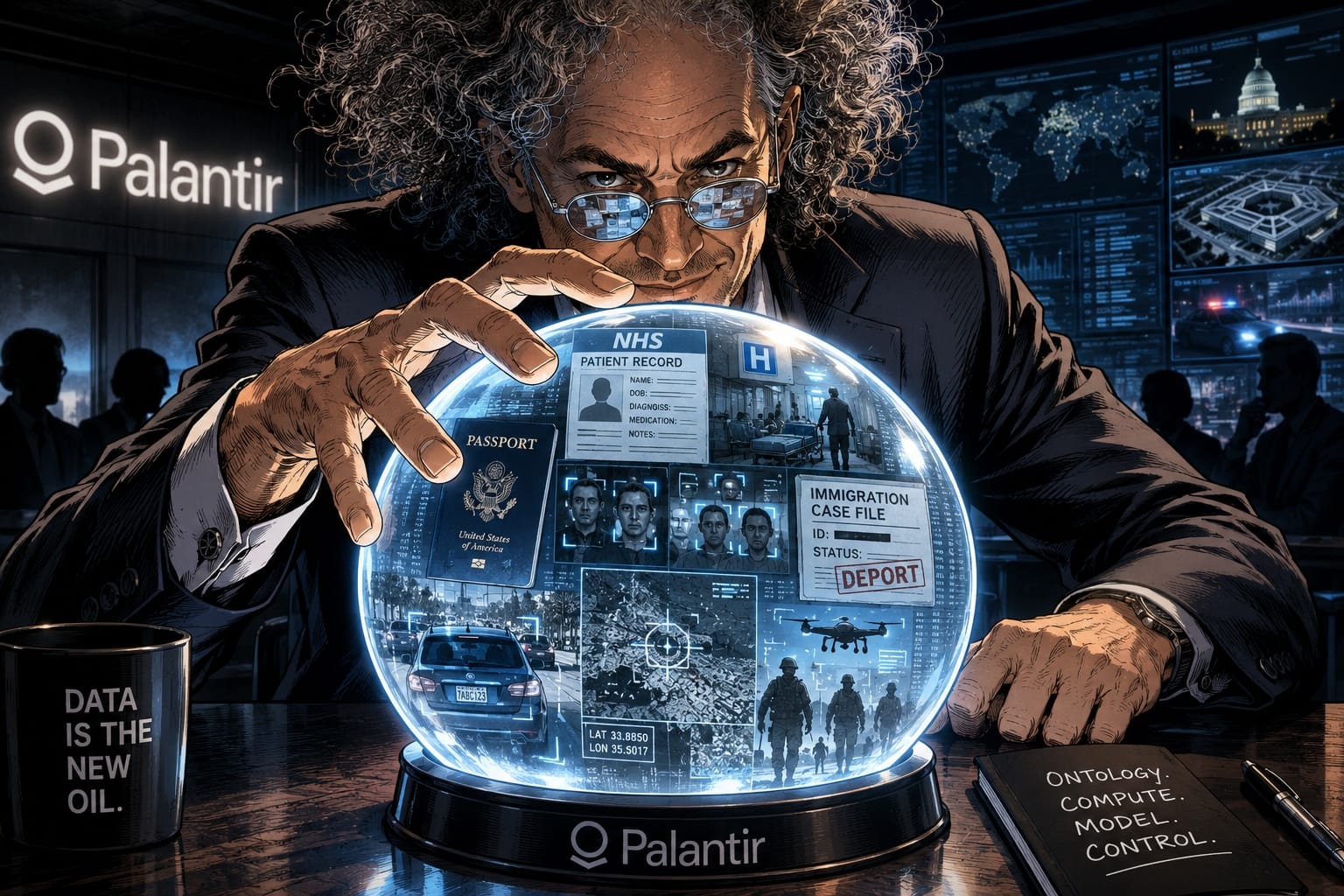
If you don't follow enterprise software or defense tech, you may not know who Alex Karp is, so a quick primer before we get to the diatribe.
Karp is the co-founder and CEO of Palantir Technologies, a data analytics company named after the all seeing crystal balls in Lord of the Rings, which is either a warning or a mission statement depending on how charitably you want to read it. Palantir was seeded in part by In-Q-Tel, the CIA's venture capital arm, and built its early business supplying intelligence agencies and the military with tools for pulling together disparate data sources into a single searchable picture. It has since expanded well past the battlefield. Palantir now holds contracts across US Immigration and Customs Enforcement, where it built the ImmigrationOS platform used to track and prioritise people for deportation, a sole source deal that has grown past a hundred million dollars and drawn sustained criticism from the ACLU and immigration advocacy groups over accuracy and oversight. It runs England's NHS Federated Data Platform, a three hundred and thirty million pound, seven year contract to integrate patient data across NHS trusts, which has been fought at every stage by doctors' groups, privacy organisations, and now an actual council motion in Sheffield calling for it to be scrapped. It has UK police contracts, Ministry of Defence contracts, and a growing footprint in insurance and financial services, where the pitch is the same as everywhere else: give us your data and we will make sense of it for you.
So Palantir is not a startup with a clever new idea about data custody. It is one of the most deeply embedded data intermediaries on the planet, sitting inside health records, immigration enforcement, policing, and defense simultaneously, frequently via contracts that are redacted, sole sourced, or both.
Keep that in mind, because on July 1st Karp sat down with CNBC's Squawk Box, ostensibly to discuss Palantir's expanded partnership with Nvidia, and instead delivered a monologue about why nobody should trust anyone with their data except, implicitly, him.
The style, before the substance
Before we get into what Karp actually said, it is worth acknowledging that the internet's reaction to how he said it was not unreasonable. Multiple outlets described the interview as a meltdown. One described it as a "televised nervous breakdown." The Squawk Box anchors visibly struggled to get a word in edgewise, and at one point Karp appeared to think the cameras had stopped rolling and kept talking anyway. A recurring joke online was that people needed an AI model just to summarise what he had said, which under the circumstances is a genuinely funny way for an AI executive's interview to be received.
It is easy, and fair, to laugh at this. Karp talks the way a browser looks with forty tabs open, each one a slightly different argument that never quite resolves before the next one starts. He interrupts himself mid sentence to interrupt that interruption. He name drops his own supposed lack of drug use unprompted, which is one of those sentences that becomes less reassuring the more you think about it. He gets defensive about not being invited to teach at Berkeley in the middle of a conversation about a chip partnership. It is, by any normal standard of media training, a mess.
But buried in the mess is an actual argument, and it is worth digging out, because it is more coherent, and more self serving, than the delivery suggests.
What he is actually arguing
Strip away the "chillaxing," the "effing insane," and the parenthetical grudge against his old university, and Karp's pitch comes down to roughly this.
A large language model on its own, he argues, is not what makes AI valuable to a serious enterprise or a government client. Value comes from three things stacked together: the model itself, an "application layer" that sits on top of it, and the compute underneath it. Palantir's application layer is something it calls an ontology, and Karp's claim is that this layer is what turns a generic model into something safe, precise, and usable in a regulated or classified context, because it prevents the underlying model from seeing, caching, or learning from the client's actual data.
From there he builds his real complaint, which is about companies like OpenAI and Anthropic. His argument is that when an enterprise or a government agency sends its data straight into a frontier lab's model via the API, it has no real visibility into what happens to that data, and no control over the weights, the compute, or ultimately the value it is generating. He frames this as an existential risk: if the thing that makes your business valuable, your "alpha" in his words, can be absorbed into someone else's model, you have effectively handed over the means of production while still paying a subscription for the privilege.
This is where the "wealth tax" line comes from, which was probably his most quotable moment. His argument is that enterprises are stuck paying indefinitely for token based access to a model they never own, extracting no lasting value, while the lab captures both the fee and, potentially, the underlying insight generated from their data. He is careful, almost performatively careful, to say this is not shade at Sam Altman or Dario Amodei personally, both of whom he calls genuinely historic figures. But the argument he is making is a direct structural attack on their business model regardless of how he dresses it up.
Then there is the Nvidia angle, which is what the interview was supposed to be about before it went sideways. His framing is that Nvidia is a compute company, not a model owner competing for the client relationship, which makes it a more natural partner for the "you keep control of everything" pitch than a frontier lab would be. Palantir plus Nvidia, in his telling, lets a client own their compute, their model weights, their data stack, and their alpha, rather than renting all four from someone else.
There is also a smaller tangent worth pulling out, because it is where the interview briefly gets pushed into something resembling a follow up question. One of the anchors asks the obvious thing: if all of this is true, are we in an AI bubble, and are we going to see enterprises pull back their spending in a quarter or two. Karp's answer is essentially no, but for a strange reason. He does not say the technology is overvalued. He says the opposite, that compute plus ontology plus model is "changing the course of history," citing Ukraine, Israel, and the US military as evidence that the underlying capability is real and durable. The bubble, in his framing, is not in the technology, it is in the pricing model. Enterprises are not wrong to spend on AI, they are being overcharged for a version of it that transfers risk to them rather than value. It is a fairly clever pivot, because it lets him agree that AI spending should continue, just funnelled somewhere other than the frontier labs' token meters.
The rest of the interview is more scattered. There is a riff on America versus China that lands somewhere between geopolitics and vibes, in which he argues the US and its allies still hold the edge on creativity and "deep tech" even as China closes the gap, and that domestic politics, both the "far left" and the "far right" in his framing, are too busy fighting culture war battles to notice that the contest is binary and someone is going to lose it. Then there is a closing stretch on Israel and Iran where he declines to say much of substance while implying there is more he could say if he wanted to, delivered with the particular confidence of a man who knows the cameras are still rolling but would like you to believe otherwise. None of this is really connected to the AI argument. It reads more like a man who has been given a live microphone and one topic, and used it for several.
The obvious problem
Here is the part that should not need spelling out, but apparently does, since Karp did not spell it out himself.
The entire pitch rests on the idea that enterprises and governments should be deeply suspicious of handing their sensitive data to an opaque, deeply embedded, arguably-too-powerful data company, and should instead route it through a trusted intermediary that keeps everything safe and under control.
Palantir is the trusted intermediary.
Palantir is also the company that runs England's national health data platform under a contract so heavily redacted that campaigners had to pursue legal action just to see what was in it, a contract that MPs are now actively debating cutting short because it may leave the NHS with no software, no intellectual property, and no lasting capability after the money is spent. It is the company whose ImmigrationOS platform pulls from passport records, tax data, and license plate readers to build profiles used in deportation operations, awarded sole source, with no independent audit of its error rate. It has a defence chief in Britain, Louis Mosley, going on television to insist that data stays in the UK and that providers cannot access it for their own purposes, which is precisely the same reassurance Karp is mocking Sam Altman and Dario Amodei for not being able to credibly offer.
Karp's own argument against the frontier labs is, verbatim, that "I'm going to trust you, you should trust me because I've never lied" doesn't cut it at this level. Correct. It doesn't. It also doesn't cut it when the person saying it runs a company whose UK head is currently on the back foot defending exactly that kind of promise to a parliament that increasingly does not believe it, and whose ICE contracts have made it the single largest surveillance technology vendor to that agency, entirely on the strength of "trust us with the data."
The charitable version of Karp's argument is a narrower, more defensible one: that a client already under contract with an auditable vendor has more recourse than one sending raw prompts into somebody's undifferentiated API, and that recourse is worth something. That is a real point. It is just not the point he made. The point he made was the much bigger, much more self flattering one, the one where the frontier labs are the untrustworthy party and Palantir is the adult in the room, delivered by a company that, if anything, has drawn more sustained institutional pushback over data trust than the labs he was criticising.
It is also worth sitting with what "trust" is actually being sold here, because the word is doing a lot of quiet work. When Karp talks about enterprises wanting to "own the means of production," meaning their compute, their weights, their data, and their alpha, the pitch sounds like independence. In practice, what he is selling is a different dependency, not the elimination of one. A client who routes everything through Palantir's ontology layer does not now own a frontier model. They own a relationship with Palantir, who sits between them and whichever model they have chosen, mediating what that model can see and do. That is a genuinely different arrangement from sending prompts straight to an API, and it may well be a more defensible one for a hospital or a defence department. But it is not "no third party has access to your data." It is "a different third party has access to your data, and that third party would like you to believe it is different in kind rather than degree." Given Palantir's own record of contracts nobody outside the company has fully seen the terms of, that is not a distinction to wave through on Karp's say so.
There is a version of this critique that applies just as well to the enterprise customers themselves, which is worth a brief detour. Karp spends a large chunk of the interview channeling what he calls "the voice of American business," describing CEOs who are privately livid about paying for tokens that generate no lasting value. Maybe that is true. It would be a much more interesting interview if any of those CEOs had been willing to say it publicly, on the record, rather than through a proxy who happens to run the company selling the alternative. Karp even invites viewers to go check this themselves, telling them to call CEOs privately and ask if they are as angry as he is. That is a strange thing to ask an audience to do live on air instead of simply producing one named executive willing to back the claim. It reads less like evidence and more like an appeal to a consensus that conveniently cannot be checked.
The short version
Karp went on television to warn enterprises not to give their most valuable data to an opaque, powerful, poorly audited tech company, and the company he was recommending they give it to instead was his own. He is not wrong that the token based, "trust us" model of frontier AI access has real structural problems worth taking seriously. He is also not the person with the standing to make that case with a straight face, and the fact that he can deliver it as a twenty minute fire hose of jargon, geopolitics, and Berkeley grievances rather than a coherent pitch does not make the underlying conflict of interest go away. It just makes it harder to notice.
Full transcript below for anyone who wants to go check the working.
CNBC Squawk Box: Interview with Palantir CEO Alex KarpJuly 1, 2026
Speakers: CNBC Host(s) (Squawk Box anchors, including one referred to as "Seema") and Alex Karp (CEO, Palantir)
[00:00] HOST: Tell us about the deal — there's so many things I think we all want to talk about, but let's get to the Nvidia deal first.
KARP: I have so much respect for Nvidia and Jensen Huang. I'm going to try to keep this more adult than I usually do, but the truth is, if you want to know how this came together from my perspective — there were a lot of technical issues: who controls the models, who controls the weights, who controls the value of your business. But, um, you know, we're sitting on critical infrastructure across America, Ukraine, Israel — everyone who uses LLMs on the battlefield runs on top of our ontology. And our clients — just to say they're unhappy with the frontier labs is to say I'm welcome at the Berkeley faculty. There's just a level of discomfort and loss of trust that also made it really, really —
HOST: Unpack that. What do you mean by that?
KARP: Well, okay, so when you're using large language models — at this point everyone technical realizes they're like a critical resource — to make them valuable in an enterprise, like a battlefield context, or regulated context, or manufacturing, you have to have what's called an application layer. We have a thing called ontology that now everyone's copying, but de facto it takes a large language model and makes it safe, useful, and precise. Safe because it doesn't touch your own learning data. Safe because it prevents the large language model from caching your data and replicating your business. Safe because it doesn't transfer your IP — how to fight, secret data, top-secret data, or in a clinical context.
So the general way these things were sold — and again, these people, I — Sam and Dario, there's nothing more fun than debating Dario in private, so this isn't me throwing shade — but something has gone completely wrong, and the basic view among enterprises in this country is: I'm going to chillax and waste my time with tokens, I'm going to get no value, and they're going to get my IP.
HOST: Well, that sounds like shade though.
KARP: Okay, and —
HOST: Not to shade — it sounds like if you're saying these —
KARP: No, no, no, no, no, sorry — this is reporting.
HOST: Okay.
KARP: And this is reporting that I've literally — against my own interest — called out. I'm profiting from this, right? So the reality is: you may not like us at my former school, Haverford, or Berkeley, but enterprises in this country trust and love us, especially ones that are involved in critical infrastructure, both public and private.
So — for those countries, we're coming up to July 4th — I want us and our friends across the globe to have the very best tech resources. In fact, the whole secret of Palantir is the forward-deployed model, the products that have been five years ahead. You've been with me for a long time. Everyone said FTEs were services. They said we don't even know what an ontology is. Now that's the only thing people talk about. The secret was we delivered the best things for the war fighters. Those war fighters have serious trust issues. But it's not just the war fighters vis-à-vis the frontier labs. Then you have my enterprises in the private sector who have the same issues. They're like, why would they get access to my data if they're going to build my alpha? Why wouldn't I control the weights? And that's where you get this partnership.
What aligns me with Nvidia — and I think what the technical customers want — is control over their compute, their models, their data stack, and their alpha. They want to know they own the means of production, that it's not being transferred to someone else. They're not interested in some fake deploy code that somehow deploys tokens and transfers the alpha to a third party. And the jig is up. So we have to figure out a way — both our products are agnostic. We now sell a product to customers that allows you to switch from model to model, because we're completely agnostic. But we need to rebuild trust, and that trust is going to happen where everyone gets to ask and answer basic questions: who owns the data, where is it cached, are the prompts secure, is this being transferred to you, are you being compensated —
If it was so valuable, let's say I can make you a billion dollars right tomorrow — wouldn't I say, I'll make you a billion dollars and I want 30%? Why are they charging for tokens if it's so valuable?
[04:22] HOST: So then, Alex, if the key — from what I'm hearing you say — is a secure, American-born, open-source model, how quickly can your model compete with frontier AI?
KARP: Well, no — what I'm saying is, yeah, okay — what I'm claiming, obviously slightly true but slightly self-centered, is it's the model plus an application layer plus compute. It's really all three. So in our jargon — just look at our financials — the reason everyone is chillaxing with bad financials and growth while losing money is the client refuses to pay the true cost.
The two places that actually make money — profit, free cash flow — are our application layer, called ontology, and compute. What I am claiming is we can take an open model, and in a classified or non-classified context, get it to the point of a frontier model — but you control the weights. So what is the true cost? Not just what you're paying — the true cost is what you make minus what you lose, meaning the value of your business. Now, we can get the frontier application to be exactly the same as a frontier model, without the risk of transferring the alpha of your business to another party. By the way, you could do this with a closed frontier model too, but then the clients have to be able to ask and answer very basic questions: are you keeping the data, are you going to enter our business —
In the classified context, when the Department of War goes to you and says, I need this application — do they get to control the weights to do it, or do you? Are we really going to outsource the battlefield of this country to the consensus view in Silicon Valley? That is effing insane. And by the way, every single enterprise in this country, in private — a lot of them don't want to speak in public because it could get outsourced to "the neurodivergent crazy person that apparently is on drugs" — the one thing I don't do. Okay, so that's my role. But I'm telling you, in this country, at every single enterprise I deal with, these people are livid. They're like, I am paying for tokens that create no value, these people are stealing the weights and alpha of my business, and they're creating a wealth tax that does not help the poor — it just punishes — starts with the billionaires, every single person at this table is going to be paying a wealth tax only to punish us. And the reason for it is because these models have been completely, irresponsibly oversold. And the sale is dangerous for everyone — which is why I can give it to all your adversaries, but I can't give it to the Department of War, or I can't safely give it to an enterprise in this country without being certain that the alpha of that business could transfer to this model tomorrow. I mean, I've got no business, no job.
[07:09] HOST: You sound pretty angry.
KARP: No, this is the voice of American business that has been channeled through me. And I'm telling you, it is absolutely a problem for this country, because we are on the cutting edge of every single AI technology. But if you're going to triply oversell something — and by the way, the enterprises are just tired of it.
HOST: But —
KARP: But, by the way, just a minute — I want everybody watching this to test what I'm saying, especially investors who think somehow this is working. Pick up the phone and call a CEO — in private, not in public. Every single person here can do this. Call two or three and say, "Mad man Karp is on TV saying we're livid" — I'm not going to quote you, you know I won't quote you, you have a history — and see if their choice is as livid as me.
HOST: So if you're right, though, does that mean we're living in some kind of terrible AI bubble, and that in a quarter, or two, or three quarters from now, we're going to hear that big enterprises are canceling their subscriptions to these products, or that their build-out is going to slow, because —
KARP: This is the tragedy of it. The reality of compute plus ontology plus model is changing the course of history. Ask the Ukrainians, ask the Israelis, ask our Department of War, ask the enterprises that are working. We do not have to oversell what we have — we have it, and it's all being built in this country. Basically, except for the open models, which is a real thing coming from China — except for Nvidia's open models, which are world-class basically — it's all being built here. We do not have to overhype it to the point where we're going to have a wealth tax punishing —
HOST: Right, but if they're charging the enterprise three times as much as they should be, and then they have to pull back on that, that changes the math of all of this.
KARP: Who's the "they"? Doesn't change the —
HOST: Large language models, which, by the way, impacts your partner Nvidia.
KARP: Okay, okay, sorry — I'm talking about the "they," the enterprises that power this country, as the most important thing. You're talking about the "they" as frontier labs in Silicon Valley — that's great, I'm focused on the enterprises of this country.
HOST: It's all falling on us.
KARP: Well, you know, it depends what they're selling — that's very downstream from us. We're completely agnostic. We prefer a world where there are more hyperscalers, where there's all sorts of new hyperscalers — Elon, Nvidia — we like that world. Why do we like that world? The same reason when you go online and there's 50 times the kinds of options, you get to pick the one you like. But what is happening among the most technical players is they're saying, I want something I own. This is my business, I want to own the GPUs, I want to own my data, I want to own the model, I want to control the alpha.
[09:54] HOST: So is that creating more opportunity for Palantir? Are you already seeing the government cancel contracts with Anthropic and OpenAI and say we want to work with Palantir?
KARP: Not here to talk about what's going to happen to the very important business of the country — except, obviously, to some extent, mine. In my business, we have much more demand than we can supply. And by the way, maybe I'm the crazy person who still only cares about free cash flow, but we have more business than we can supply, and if you just look at our financials, you can see, two years out, 15, 18 billion dollars in free cash flow.
HOST: Sorry — are you frustrated by the stock's performance over the years?
KARP: You know what? I've been at this for 20 years. When we first started, people were like, is this a services company, is it worthless? The markets are short-term, very fickle — and, quite frankly, where I would throw some shade: what investors actually understand tech? They think, because they're very high-IQ and they understand certain things, they understand what they're using. Basically the fault of investors is typically, "I use it, therefore it's valuable." Yeah — when an enterprise uses it doing complicated manufacturing, or pharmacological research, or putting a bomb on target, or bringing special forces people home safely, that's very different from what you're using.
HOST: If you're a pharmaceutical company, or you're the government, should you not be using Anthropic or OpenAI without your layer on top? Is that dangerous for them?
KARP: Look, first of all, honestly, the one thing I am slightly frustrated about is that when OpenAI or Anthropic especially are talking about critical infrastructure, it's only being used in our product, my product. And there's a reason for that — these things are very, very valuable.
What they have done in building models is world-historic. And just so you see I'm not throwing shade — Dario is literally a historic figure. He came from behind and he's now number one. Almost no one in the world — I've been in business, whatever you want to call what I do, for a long time — I've never seen anything like this. Okay, so the reality is: critical infrastructure does not run these models without an application layer. In almost all cases — and maybe it won't be all cases someday — that application layer is an ontology. That's a fact, and there's a reason for it. It's not that some people love me, some people hate me, and they're buying because of that — they're buying because these things have to be made safe. And "trust me, I've never lied" just doesn't cut it at this level.
Enterprises are run by the shrewdest, most wily, intelligent people on the planet. If you think they're going for that — you can go try to sell me — my parents still want me to get a job as a faculty member at Berkeley. Go try to get me a job at Berkeley. I'm very qualified. It's not happening.
[12:57] HOST: Do you agree with the notion that the most robust, powerful AI models should be withheld from the public due to cybersecurity risks?
KARP: Look, I think — one of the things we're really trying to get the West to do is move away from — these are very technical questions: what does the model do, who is restricting it. I would say it is a loser move to restrict something from your own government because you don't agree with how the government fights war, and then open it up to the world, including our adversaries. Go sell that to the American people, where they already don't like you.
HOST: You have a lot of data that you look at. Do you think China is getting better at AI? How is the gap narrowing?
KARP: There are two relevant tech centers, and two and a half: America, China, Israel — those are the tech centers of the world. I spent half my life in Europe, I want Europe to be relevant — Sweden has a real tech scene — but the relevant tech centers, we have a peer-to-peer adversary in China. China has a lot of advantages, including — quite frankly, we have to find ways to make these models raise the standard of living for every American, and Americans need to have a sense that it's not just the people at the — and people watching it — getting rich. There are real issues there.
And then we have left and right — far left, far right — gone completely nuts. You would think that the greatest problem in the world, if you were on the far left, is somehow that if things work, it's evil and bad. By the way, I've been wholesale kicked out of my own party because I warned that this was going to happen on the left, and it is happening. Then on the far right, it's like — on both sides you'd think the biggest problem of our society is warlocks roaming the street building technology. Of course they can't understand it — they attack Palantir for the craziest reasons. China doesn't have that problem. But it also doesn't have the creativity, ingenuity, and deep tech creativity we have. But the reality is it's not a foregone conclusion that we win. The biggest problem in this country in these debates is we debate these things as if we don't have adversaries. That's not actually true. It's binary — they will win, or we will win.
[15:12] HOST: Let me pivot to a slightly different conversation, but related. You've been a proponent and great supporter of Israel over the years. And right now we have a ceasefire in the Middle East, which we hope holds. Having said that, there is a bit of space between where the US is now and where Netanyahu is on what's happening here, and whether they'll ultimately be protected. I'm curious, given that, and given your relationship with the US government and the work you do there, how do you think about that disconnect?
KARP: This is like so many things — I am the most publicly supportive CEO of Israel. That's true. I think Israel is on the side of good. Now, in private — because I'm known there to be, to be fair, probably also the most effective critic — it's like, "Hey, I didn't agree with this." So, without going into more of that in public — except, I think, not all, there are many legitimate criticisms of Israel, and of every other country. Although, I would say: do you want a country that can sometimes be difficult as your partner, or do you want partners who aren't even seen as a partner? In this world, having a fully adult, independent, aligned country that doesn't always agree with us is much better than what we somehow have in Europe. We do not want that.
Look, America and Israel will never be fully aligned, and that's totally okay. My position is they are a very important partner, and we are proud to support them — and in private, you can bet your last dollar I call and complain about a lot of things.
[16:53] HOST: So what do you think of this MOU, or whatever deal is on offer — and whatever that deal is — do you think we're now in a better place than we were before with Iran, and also what do you think it means for Israel?
KARP: Well, look — I'm going to leave the Israeli thing for my conversations with them in private, because I just don't think at this point it's easy to talk about them in public — you just get — look, there are legitimate criticisms of Israel. Half the people criticizing Israel just don't believe it should exist, and that's just a fact. So I'm not going to totally play into their hands by saying things I say in private. In America, America has to represent its own interests. Do I think Iran's been degraded? Yes. Are there things I don't think are in the public space that would be comforting to people if they knew them? Yes. And I'll leave it at that.
[17:46] Closing exchange
HOST: Wow. Pretty great.
KARP: Thank you.
HOST: Thank you. You don't have to get up from the seat yet.
KARP: You know, I just feel like I'm going to be kicked out of the room.
HOST: No. Never — lively and engaging conversation. We really appreciate your time.
HOST: No, not like your party — we want you to stay. Can you come back tomorrow?
KARP: Yeah, no, I'll come back. I really do appreciate you guys.
KARP: You know, the thing I actually like about you guys the most when I watch you is that you actually — and it's very hard to pull this off — you actually have divergent opinions, and somehow you guys stay together.
HOST: This is true. We're still on camera.
KARP: Oh yeah, well, great. That's true — it's honestly so boring, the other stuff. I get kicked out of these rooms. Even if I agreed with you, I would try to disagree with you — it's more fun.
HOST: There's Seema — thank you for bringing Alex here this morning. Thank you for your perspective on this. Alex, thank you, we appreciate it very, very much.
KARP: Thanks. People live in echo chambers... you get offended by the divergent opinion. It's so crazy. And I'll tell you, we're off camera now.
HOST: No, we're still going.
KARP: Let me get off camera.
(Segment closes; anchors move on to read a news update about President Trump speaking to reporters at Joint Base Andrews ahead of his flight to North Dakota.)
Transcript compiled from CNBC "Squawk Box" audio/caption files (July 1, 2026). Fragmented captions merged into full sentences for readability; speaker turns follow the original caption breaks. Minor false starts and filler words trimmed where they didn't affect meaning; substantive content preserved verbatim.