Peter Thiel and the Politics of Apocalypse

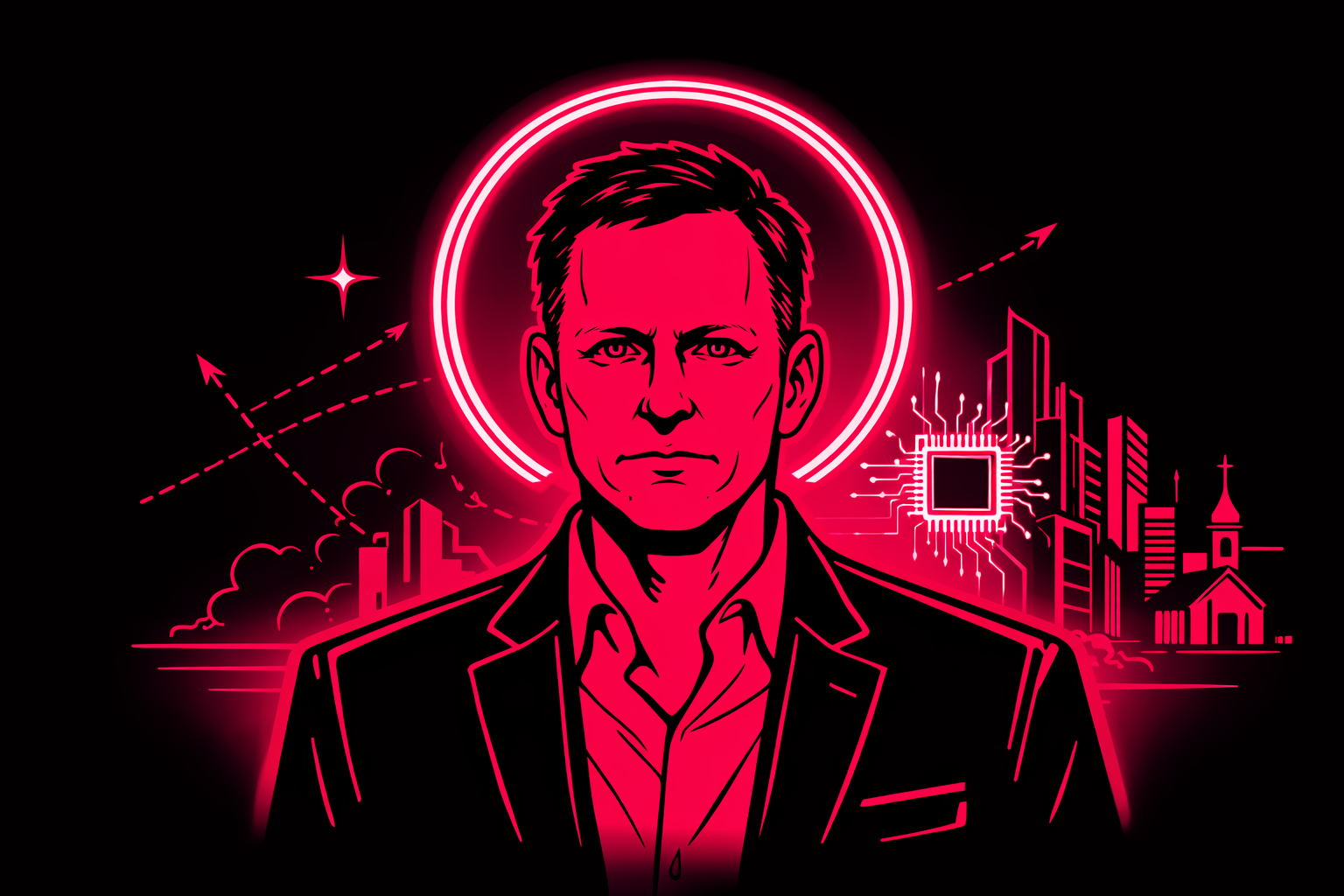
There are moments when a piece of rhetoric stops you in your tracks, not because it is profound, but because it reveals a strange tear in the fabric between worlds. That is exactly how it felt encountering the resurfaced “Antichrist” lecture that’s been circulating recently, especially through the two-part Behind the Bastards series dissecting it. I found myself going down the rabbit hole further, reading the preserved version of the talk on the Wayback Machine, trying to understand how on earth a figure like Peter Thiel has ended up invoking Antichrist imagery to an audience primed to receive it literally. The more I sat with it, the more dissonant the whole thing became, because Thiel is absolutely not a Christian in the sense ordinary people use that word. If anything, he seems almost allergic to the ethical, communal, compassionate aspects of Christianity. He’s not a church-goer, not a Bible reader in the devotional sense, not a WWJD moralist. My own parents are practising Christians, the kind who live their values quietly and kindly, and nothing Thiel says or does resembles anything they would recognise as Christian in spirit or substance. Yet somehow, he has begun speaking the language of Revelation in ways that resonate with people who genuinely see the world through that lens. That contradiction is the doorway into understanding the political project underneath.
See also: JD Vance's Top Donor Suggests Pope Leo XIV is Antichrist.
What struck me immediately is that Thiel’s engagement with Christian apocalyptic themes is clearly not about belief. It is about utility. He is not speaking as a believer to believers. He is speaking as a strategist to an audience whose cosmology he has studied well enough to manipulate. Evangelicals are uniquely primed for narratives of cosmic threat, final tyranny, and world-ending conflict. Their theological vocabulary already includes ideas of a global authoritarian state, a charismatic world leader, technological control systems, mass deception, and spiritual warfare. For many, these aren’t metaphors. They are cognitive frameworks they’ve carried since childhood, reinforced by sermons, prophecy conferences, Christian books, political radio, and the ambient culture of American evangelicalism. If you speak that language well enough, you can mobilise an enormous political bloc without actually sharing their worldview. Thiel’s brilliance, or cynicism depending on how charitably you view it, is that he has realised he doesn’t need to be a Christian to wield Christian prophecy. He simply needs the appearance of alignment to tap into the emotional power those narratives hold.
The heart of the irony is almost too on-the-nose. Here is a billionaire tech investor, a Nietzsche admirer, a man who helped found one of the world’s most powerful surveillance companies, a man who openly argues that democracy is incompatible with freedom, a man who finances authoritarian-leaning political candidates, a man who champions “exit” from democratic norms, invoking the Antichrist to warn America about tyranny. The irony is so thick you could carve it into wafers and serve communion with it. And yet this is not merely amusing. It is strategically revealing. Because if you list the characteristics evangelicals traditionally associate with the Antichrist, the figure they warn about in sermons and tracts, Thiel lines up with them more closely than the institutions he claims represent the final tyrant. Evangelicals fear a unified global governance structure, mass surveillance, the merging of corporate power and political power, the erosion of democratic accountability, the elevation of technocratic elites, and the emergence of a charismatic figure who shapes the future not through God, but through a kind of cold hyper-rationality. Thiel is not that figure, but he openly supports the ideology, the political framework, and the technological apparatus that would make such a figure possible.
The question then becomes: why would he invoke the very imagery that, if taken seriously, would place suspicion directly on him and his allies? The answer is projection as a political technology. Authoritarian movements routinely accuse others of the very abuses they intend to commit. It is a kind of moral inoculation. If you frame your opposition as tyrannical, demonic, corrupt, or spiritually dangerous, you can justify extreme measures in the name of resisting them. You also rewire the narrative landscape so that accusations directed at you can be dismissed as deflection or persecution. Thiel’s use of Antichrist rhetoric is not a slip or a contradiction. It is an inversion. It is a way of casting the “Cathedral” in neo-reactionary terms, meaning universities, media, cultural institutions, regulatory bodies, and democratic structures, as the true seat of evil, while positioning his own project as a necessary corrective, even a moral crusade.
Behind the Bastards touched on this strategy, but the deeper mechanics deserve more attention. Evangelicals don’t just respond to apocalyptic imagery. They organise around it. Fear of the Antichrist is not simply a theological concern. It is a way of sorting the world into allies and enemies. If Thiel can convince that audience that the ultimate tyrant is the secular liberal state, not the private corporate technocracy he champions, then he gains access to a vast, highly mobilised voting bloc ready to defend his political allies with religious fervour. He taps into a worldview where compromise is suspect, where institutions are distrusted, and where dramatic political action is justified by a sense of cosmic urgency. It doesn’t matter that his life bears no resemblance to evangelical virtue. It matters that he can speak their eschatological language well enough to convert their anxieties into political capital.
This is why the archived lecture is worth examining closely. It reveals not just a fascination with apocalyptic themes, but a deliberate blending of technological, political, and theological fears into a coherent narrative of looming tyranny. The Antichrist here is not a literal figure with horns or a barcoded forehead. It is a metaphor for the end of agency, the rise of systems that dominate human life, the merging of surveillance technology with political control, and the idea that a small group of elites might shape the world’s destiny without democratic input. The irony, again, is that Thiel is one of the people actually building the infrastructure that could make such a system possible. But because he casts his opponents as the threat, he diverts attention away from his own role in that process.
What makes this strategy even more potent is that Thiel is not working in a vacuum. He is part of a broader alliance between techno-libertarians, neo-reactionaries, and Christian nationalists that has been forming quietly but deliberately for more than a decade. The connecting thread is not shared belief but shared enemy. For the neo-reactionaries influenced by Curtis Yarvin, the problem is the so-called Cathedral, the diffuse web of institutions that uphold liberal democracy. For Christian nationalists, the problem is secularism and multiculturalism eroding the imagined Christian foundation of American life. For techno-libertarians, the problem is regulation that threatens innovation and profit. These groups disagree on theology, morality, and the nature of the good life, but they agree that democratic institutions stand in the way of what they each believe is necessary for national restoration or technological transcendence. Thiel has become the unlikely bridge figure who can speak enough of each group’s language to pull them toward a shared project.
This is why the Antichrist rhetoric is so useful. It functions as a universal metaphor for a centralised enemy that threatens freedom, agency, identity, and destiny. Evangelicals hear prophecy. Yarvinites hear critique of the managerial bureaucracy. Tech elites hear warnings about sclerotic political structures that impede innovation. They are all hearing different things, but the metaphor binds them together. It allows Thiel to speak across ideological boundaries without being pinned down to any one tradition. He is not evangelising Christianity. He is evangelising anti-democracy using Christian aesthetics as a delivery mechanism. That is a crucial distinction. He is not trying to win souls. He is trying to win coalitions.
What makes this coalition genuinely dangerous is the way it blends emotional urgency with technocratic ambition. Evangelicals bring fervour, mobilisation, and a sense of cosmic purpose. Tech elites bring money, infrastructure, and the promise of technical solutions to structural problems. Neo-reactionaries bring the ideological scaffolding for replacing democratic governance with CEO-style sovereigns. The result is a movement that sees democracy not as a flawed but necessary system, but as a historical aberration, an unscalable technology that must be replaced by something more efficient and more aligned with the elite’s vision of order. When Thiel speaks of the Antichrist, he is not describing a supernatural villain. He is describing the democratic state. Once that metaphor lands, everything becomes permissible in resisting it.
But the rhetorical sleight of hand runs even deeper. Evangelicals have historically feared the merging of government and private power, especially when mediated through technology. They fear surveillance, centralisation, and the collapse of local autonomy. Yet Thiel is deeply involved in the very projects that embody those fears. Palantir is not just a tech company. It is one of the most intimate pipelines between private industry and state surveillance in modern history. It has been embedded in law enforcement, intelligence, immigration, and military operations. Its entire business model is predicated on centralising data in ways that give unprecedented visibility into people’s lives. If an evangelical pastor from 1995 had been asked to imagine a company that looked vaguely like the infrastructure of the Mark of the Beast, they would have described something that sounds like Palantir. And yet here is one of its founders warning about tyranny while pointing the finger elsewhere. It is cognitive dissonance turned into political theatre.
This raises a deeper psychological point that deserves attention. Humans are wired to respond to narratives of threat with heightened emotion, accelerated tribal identification, and reduced critical reasoning. Apocalyptic frameworks heighten this even further. When Thiel invokes eschatological language, even subtly, he activates pathways of fear and urgency that make his audience more receptive to drastic solutions. It is not that people stop thinking. It is that they start thinking in binaries. Good versus evil. Us versus them. Truth versus deception. This is ideal terrain for political operators who want to bypass institutional constraints and mobilise support through identity rather than argument. Apocalyptic language is a kind of cognitive shortcut. It collapses complexity into moral clarity and turns political disagreements into cosmic battles. Once that frame is activated, compromise becomes capitulation. Negotiation becomes weakness. Opposition becomes wickedness.
Thiel’s relationship to Christianity must be understood through that lens. He is not engaging with Christian doctrine or ethics. He is engaging with the psychological architecture that Christian eschatology provides. He is speaking to the parts of the evangelical imagination that respond to story, symbol, prophecy, and cosmic struggle. The fact that he does not live the moral life evangelicals champion is irrelevant for his strategy. He does not need to embody their values. He only needs to embody their fears. And fear, when invoked skilfully, can overshadow incongruities that would otherwise seem glaring. Evangelicals who would reject a gay, Nietzsche-reading billionaire as a leader in any other context are willing to listen to him because he can make them feel that he understands the nature of the threat. He does not need to be one of them. He just needs to sound like someone who sees what they see.
This is why the Behind the Bastards episodes analysing this phenomenon were so illuminating. They reveal the absurdity of the situation, but also the emotional seriousness with which these narratives operate. The irony of Thiel warning evangelicals about the Antichrist is almost comedic on the surface, but beneath it is a precise understanding of how political narratives function. Evangelicals are not primarily moved by policy proposals or strategic white papers. They are moved by moral drama. Thiel is not giving them theology. He is giving them drama. He is giving them a story in which they are the embattled faithful resisting a coming darkness. In that story, it does not matter that the messenger is not one of them. It only matters that the message resonates.
The deeper you go into this dynamic, the clearer it becomes that Thiel’s invocation of apocalyptic Christian imagery is not accidental or half-baked. It is part of a coherent worldview in which democracy is seen not as a stabilising force but as an obstacle. His famous line that he “no longer believes that freedom and democracy are compatible” is not a throwaway comment. It is a thesis statement for his political imagination. He frames democracy as the system that empowers the masses at the expense of the exceptional, the visionary, the competent. For someone who believes that progress is driven by a small number of unusually capable individuals, democracy becomes a kind of tyrannical ballast, a force that holds back the transcendence he imagines for the future. This is where the neo-reactionary influence of Curtis Yarvin becomes most visible. Yarvin’s whole project is the dismantling of the democratic state in favour of what he calls “formalism,” a reversion to monarchic or CEO-style rule where sovereignty is centralised and unchallenged. The Antichrist, in this schema, is not a supernatural villain but a metaphor for the managerial bureaucracy that constrains the sovereign’s will.
This conceptual blending of theological apocalypse and political theory is precisely why Thiel’s rhetoric can resonate across such different audiences. He is not asking evangelicals to adopt Yarvin’s monarchy fantasies. He is asking them to see the same enemy through a different lens. For evangelicals, the enemy is the secular state. For Yarvin and the tech elite, the enemy is the administrative state. For Thiel, these are the same thing. By wrapping his critique of democratic governance in apocalyptic Christian imagery, he gives it emotional weight and spiritual urgency. It becomes not just a political argument but a cosmic argument. And once a political argument ascends to cosmic stakes, it is shielded from ordinary scrutiny. It becomes something sacred, something that must be defended regardless of the costs.
This is also why Thiel’s contradictions do not undermine his credibility among the audiences he is courting. Evangelicals may object to his lifestyle in theory, but they are willing to overlook it because he validates their fears. Tech elites may roll their eyes at religious language, but they are willing to tolerate it because it provides a bridge to a vast bloc of voters whose support is necessary for advancing deregulatory agendas. Neo-reactionaries may find the Christian framing quaint, but they see it as a useful tool for destabilising the democratic consensus. Everyone involved is playing a role in a larger performance, a performance that aims to align different anxieties toward a single shared conclusion: that the current democratic order is failing and must be replaced.
When Thiel warns about an Antichrist-like figure rising from global institutions, he is not warning against authoritarianism in the traditional sense. He is warning against a world in which the state retains enough power to regulate corporations, enforce democratic norms, and constrain the ambitions of tech elites. In his framing, authoritarianism is not the danger. The danger is any system that limits the sovereignty of those he believes are best suited to shape the future. This is why the Antichrist narrative becomes such a useful political tool. It transforms policies that would normally be seen as elitist power grabs into defensive measures against an encroaching evil. It casts deregulation, centralised corporate governance, and the weakening of democratic oversight as acts of resistance rather than domination.
But there is another layer to this that deserves attention. Apocalyptic narratives often create a sense of historic inevitability. If one believes that the end is near, that collapse is coming, then the urgency of the moment justifies drastic action. Thiel’s rhetoric operates in this register. It suggests that we are approaching a civilisational inflection point, a moment where technology, politics, and cultural decay converge into crisis. In this reading, the future will not be shaped by incremental change but by decisive action taken by those who have the courage to see the truth and the power to act on it. This vision is deeply compatible with authoritarian thinking. It positions a small elite as the only ones who understand the stakes and the only ones capable of steering society through the transition.
This makes evangelical apocalypticism and techno-accelerationism unlikely but powerful allies. Evangelicals believe the end is coming because prophecy says so. Tech elites believe the end of the current order is coming because technological disruption makes it inevitable. Both groups see themselves as chosen or special in some way. Both see the present as corrupt or failing. Both believe that suffering or upheaval may be necessary to bring about a higher order. And both, crucially, are willing to tolerate or even welcome the dismantling of the existing system if it means achieving their version of salvation. When Thiel speaks of doom, he is not speaking about divine judgment. He is speaking about historical opportunity.
Critically, this blending of eschatology and accelerationism obscures what is actually happening on the ground. While Thiel warns of tyranny emerging from the state, he is actively investing in technologies that increase corporate surveillance, algorithmic control, and data-driven governance. While he frames the future as a battle between freedom and oppression, he supports political candidates who seek to restrict voting rights, undermine democratic norms, and concentrate power. While he evokes imagery of spiritual warfare, he finances movements that erode civil liberties in ways that would horrify the very Christians he addresses. The rhetoric of resisting tyranny becomes a smokescreen for constructing a new form of it. It is a moral hall of mirrors. Everything is reversed.
This reversal works because apocalyptic narratives allow for moral simplification. In an apocalyptic frame, enemies are not just misguided. They are evil. Threats are not just political. They are existential. Once that shift occurs, people feel justified in supporting aggressive or even authoritarian measures, believing that the stakes demand it. If democracy becomes associated with the Antichrist, then undermining democracy becomes a righteous act. If regulation becomes associated with tyranny, then dismantling regulation becomes liberation. If pluralism becomes associated with corruption, then imposing a singular cultural vision becomes purification. Thiel is not offering evangelicals a theological revelation. He is offering them a political excuse.
What truly brings the whole picture into focus is that Thiel does not behave like a man who fears the coming of a tyrant. He behaves like a man who believes the current world is already too democratic, too decentralised, too slow for the kind of civilisational leap he imagines. His investments, writings, and political alliances all point toward a future where sovereignty is concentrated, where governance is streamlined, where citizens are more subjects than participants. He sees democracy as a bottleneck, not a safeguard. And this is where the Antichrist rhetoric becomes not just ironic, not just manipulative, but genuinely dangerous. Because he is not warning evangelicals about the dangers of concentrated power. He is warning them about the wrong people having that power. The problem, in his story, is not tyranny. The problem is who the tyrant would be.
This dynamic reveals a deeper truth about political psychology: people are often far more comfortable with authoritarianism when they believe the authoritarian will align with their interests. Evangelical support for Donald Trump, despite his complete lack of Christian character, demonstrated this with startling clarity. When people believe the stakes are existential, they will accept almost any leader who promises to defend them. Thiel understands this. He understands that if he frames the future as a cosmic battle, people will tolerate or even celebrate measures they would otherwise oppose. He understands that if he can convince a large and fervent bloc that the democratic state is the face of approaching tyranny, then any alternative he supports will appear as liberation by comparison. The danger is not that evangelicals will follow him into atheism or technocracy. The danger is that they will follow him into anti-democracy without realising it.
What makes this even more insidious is the way Thiel’s rhetoric taps into pre-existing fears that have been cultivated for decades. American evangelicalism has been priming its members to distrust secular institutions since at least the Cold War. Schools, universities, Hollywood, the media, the government, international organisations, public health institutions, scientific bodies, and cultural elites have all been cast as potential instruments of Satanic deception or moral decline. This long-running suspicion means that the ground is already fertile. Thiel does not need to plant new seeds. He only needs to water the ones that are already there. When he speaks of tyranny, his audience does not think of surveillance capitalism or corporate control. They think of the institutions they have been warned about since childhood. That psychological wiring is one of the most powerful political forces in America, and Thiel has learned to play it like a violin.
From a psychological perspective, what we are seeing is a merging of eschatological fear and techno-political ambition into a single narrative. It is a kind of ideological hybrid, one that allows different groups to project their own anxieties onto the same imagined enemy. For evangelicals, the enemy is the secular global state. For Thiel and his allies, the enemy is the democratic regulatory state. The fact that these enemies are, in many ways, the same institutions makes the coalition stable. They are united not by what they want to build, but by what they want to dismantle. Once that shared mission is established, the details of what comes after become less important. The future becomes a blank canvas onto which each faction can project its utopia. Evangelicals imagine a restored Christian nation. Tech elites imagine a streamlined, efficient technocracy. Neo-reactionaries imagine a corporate monarchy. All three visions are incompatible, but they can coexist long enough to undermine the system they oppose.
This is why the Antichrist rhetoric matters. It is not about predicting the future. It is about authorising a particular set of political actions in the present. It tells people that the world is on the brink, that drastic measures are justified, that old rules no longer apply. It primes them to see institutional collapse not as a catastrophe but as a necessary purging. It transforms the erosion of democratic norms into the fulfilment of prophecy. And once people see political events as part of a cosmic script, they become much harder to reach through ordinary political persuasion. They become committed not to a candidate or an agenda, but to a narrative of salvation and survival. That is a level of psychological commitment that technocratic rhetoric alone could never achieve. Thiel has found a way to harness it without ever fully joining it.
The final, unsettling question is what Thiel actually wants the post-democratic future to look like. His writings and investments suggest he envisions a world governed more by corporations than by states, where technological power overrides political debate, where sovereignty is exercised through ownership rather than elections. It is a world where the people who build the future get to decide what that future is. In this vision, democracy is not a moral ideal. It is an outdated operating system. And Apocalyptic Christian imagery becomes a convenient way to persuade millions of people to help uninstall it.
The danger is not that Thiel believes he is a prophet or that he sees himself as a spiritual figure. The danger is that he has learned how to speak like one. In a country where millions already interpret world events through an apocalyptic lens, the ability to mimic that language is a political superpower. It allows him to cloak elite interests in sacred symbolism. It allows him to turn his own ambitions into a form of moral resistance. And it allows him to build a coalition that would otherwise have no reason to align with him. The Antichrist he warns about is not a supernatural villain rising from the ashes of a broken world. It is an illusion, a projection designed to distract from the very real authoritarian trajectory he supports. The irony, as always, is almost too sharp to bear.
And yet this is precisely why the conversation matters. If people who do not share evangelical beliefs can see the machinery behind Thiel’s rhetoric, they can understand how the manipulation works. They can recognise that the threat is not prophecy but politics. They can see that the greatest danger comes not from the institutions he demonises, but from the forces quietly gathering behind the scenes to replace them. The future Thiel imagines is not inevitable. It is engineered. And the first step in resisting it is seeing through the aesthetic that cloaks it. He does not need to believe in the Antichrist to invoke it. He only needs others to believe the battle has already begun.