AI’s $1 Trillion Lie: The Data Centers That Don’t Exist

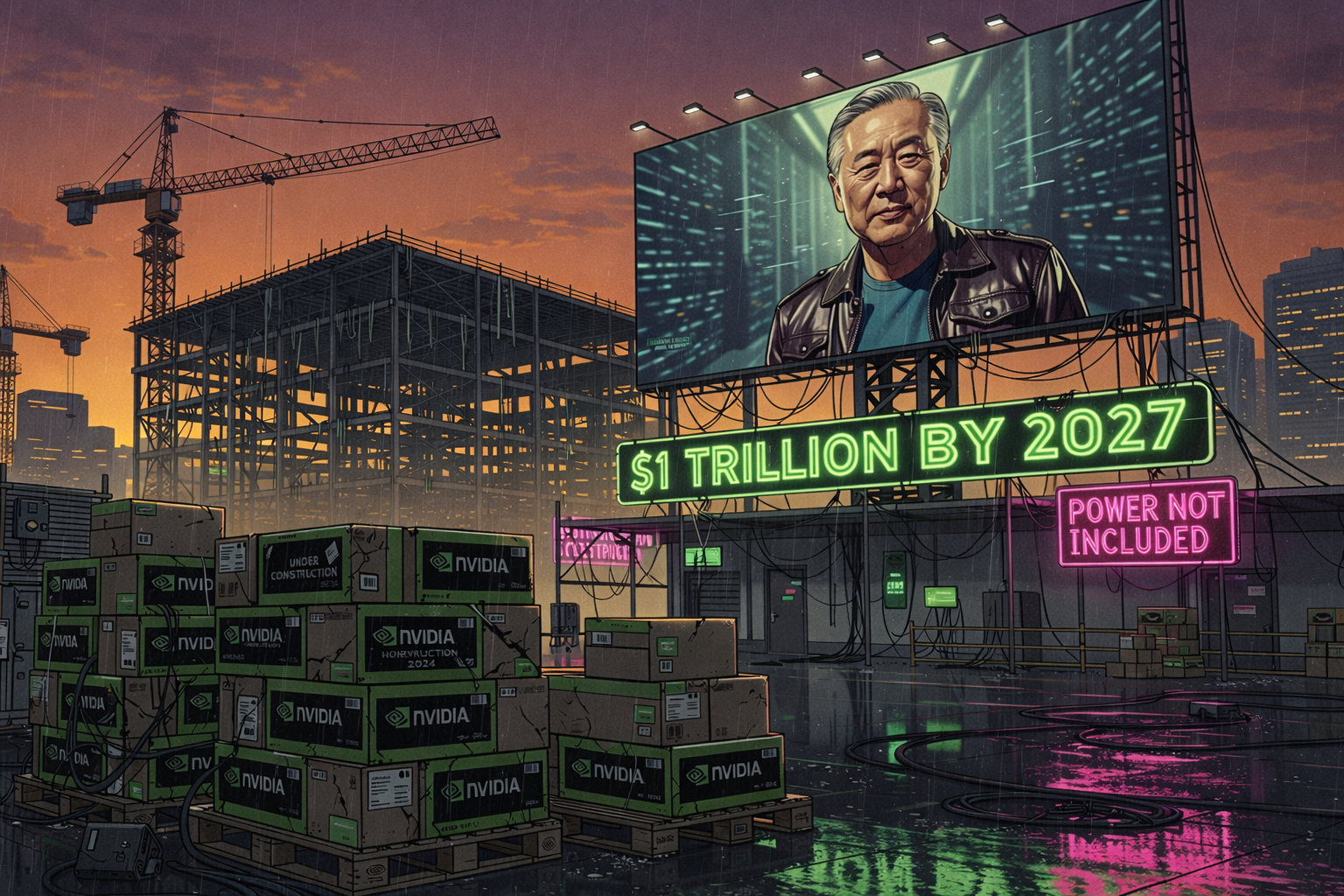
Adapted from Ed Zitron’s Where’s Your Ed At?
Introduction: The AI Bubble’s Shaky Foundations
The AI industry is selling a dream: endless progress, unstoppable innovation, and a future where artificial intelligence solves every problem. But as Ed Zitron argues in his latest newsletter, the reality is far messier. The entire ecosystem is built on overpromised data centers, uninstalled GPUs, and financial sleight of hand. Behind the hype, the infrastructure powering AI is crumbling under its own weight—literally.
Zitron’s analysis reveals a stark disconnect between the AI industry’s ambitions and its actual capabilities. Companies like NVIDIA, Microsoft, and OpenAI are announcing multi-billion-dollar projects, but the data centers needed to run them are delayed, underpowered, or nonexistent. Meanwhile, investors and media outlets cheer on the boom, ignoring the growing evidence of a looming bust.
This isn’t just a story about tech. It’s a cautionary tale about how hype distorts markets, how debt fuels illusions, and how the people paying the price—workers, taxpayers, and even students—are the last to know.
1. The Data Center Mirage: 241GW Announced, Only 3GW Built
The Numbers Don’t Add Up
In late 2025, economist Paul Kedrosky highlighted a troubling trend: new US data center capacity additions halved in Q4 2025 compared to the previous quarter. Wood Mackenzie’s report was even blunter:
“US data-centre capacity additions halved from Q3 to Q4 2025 as load-queue challenges persisted. The decline underscores the difficulties of the current development environment.”
But here’s the kicker: Only 33% of the 241GW of announced data center capacity is under active development. The rest? A mix of “hopeful permits, speculative land deals, and projects that assume power sources nobody has actually built yet.”
| Metric | Claimed | Reality (2025) |
|---|---|---|
| Total announced capacity | 241GW | 241GW |
| Under active development | 79.5GW (33%) | ~3GW actually built |
| Power commitments | 58% “wires-only” | No generation |
| Capex spending | $948 billion | Growth decelerating |
What “active development” really means:
- “Under development or construction” can mean anything from “we’ve got the land” to “we’re still figuring out what to do with it.”
- Only 3GW of new data center capacity was brought online in 2025—enough to power a fraction of the GPUs already sold.
Zitron’s estimate: “North American data center absorption—actual, turned-on, revenue-generating capacity—was around 3GW for 2025.”
That’s $90 billion worth of NVIDIA GPUs and associated hardware, sitting idle or stuck in warehouses.
Why the Slowdown?
Three major bottlenecks:
- Power shortages: PJM, a major US grid operator, has committed to data centers at three times the rate new generation is coming online. Someone’s going to be waiting a long time—or paying a lot more.
- Construction delays: Building a data center isn’t like assembling IKEA furniture. Stargate Abilene, a flagship project for OpenAI and Oracle, was announced in 2024 with a 200MW target for 2025. By March 2026, only two of eight buildings were operational.
- Media complicity: Outlets like CNBC declared Stargate “up and running” when just 12.5% of its capacity was live.
Zitron calls this “a blatant coverup with the active participation of the press.”
- Microsoft’s UK “supercomputer”? Still a scaffolding yard.
- Meta’s 1GW Indiana campus? Broke ground in February 2026—years after the hype.
2. NVIDIA’s $1 Trillion Gamble: Selling GPUs No One Can Use
The Sales vs. Installation Gap
NVIDIA’s CEO Jensen Huang has promised $1 trillion in GPU sales by 2027. But there’s a catch: It now takes six months to install a single quarter’s worth of sales.
- Q4 2025 data center revenue: $135 billion (US only).
- Uninstalled GPUs: ~$44 billion worth, gathering dust.
- Installation timeline: If trends hold, 2025 and 2026 revenues won’t be fully operational until 2028 or later.
Zitron’s question: “What’s the fucking point of buying these things two to four years in advance? Jensen Huang is announcing a new GPU every year!”
The Blackwell Problem
NVIDIA’s latest Blackwell GPUs require more power and cooling than older models, meaning they can’t just slot into existing data centers. Yet hyperscalers like Microsoft and Meta keep buying them—years before the facilities to house them are built.
- Example: Nebius raised $3.75 billion in debt based on a Meta deal for capacity that doesn’t exist yet.
- Reality: Nebius’s Vineland, NJ data center was supposed to hit 100MW by late 2025. As of February 2026, only 50MW was available.
The math is brutal:
- NVIDIA sells 1.6GW of GPUs every quarter (in IT load terms).
- Only 5GW of global data center capacity is under construction.
- Result: A $111.5 billion backlog of GPUs with nowhere to go.
3. The Financial Shell Game: Debt, Private Credit, and Pension Funds
Who’s Funding This Mess?
Private credit firms—eager to cash in on the AI gold rush—are throwing money at data center projects with little oversight.
- Nebius: $3.75 billion in debt, secured by a Meta contract for theoretical capacity.
- Crusoe (Stargate Abilene): $3.4 billion raised in 2024; still not fully built in 2026.
- Nscale (Microsoft’s UK project): $3.3 billion for a site that’s still under construction.
Zitron’s warning: “These deals are trash. They’re never getting built, and the debt is piling up.”
The Pension Fund Problem
Private credit doesn’t just magic money out of thin air. Much of it comes from pension funds and insurance companies—meaning your retirement savings might be propping up these risky bets.
- Interest payments are mounting as projects drag on.
- GPUs depreciate: By the time data centers are ready, the hardware inside may be two generations old.
4. The AI Startup Ponzi Scheme
Burning Cash, Chasing Hype
AI startups aren’t just buying GPUs; they’re losing hundreds of millions per year to do it.
- Example: Inflection AI spent $1.3 billion in 2025 for $12 million in revenue.
- Pattern: Raise money, buy GPUs, promise breakthroughs, repeat.
Zitron: “Pretty much every AI startup is in SaaS and raises hundreds of millions of dollars so that it can make single or double-digit millions of dollars a month.”
The Hyperscaler Trap
Even giants like Microsoft and Google are not immune:
- Microsoft’s Wisconsin data center: Announced as the “world’s most powerful AI data center” in 2025. As of 2026, it’s barely operational.
- Google’s Tennessee campus: Delayed indefinitely due to power concerns.
The bottom line: “The entire AI bubble is a god damn mirage.”
5. What Happens When the Music Stops?
Three Possible Outcomes
- The Slow Collapse: Data centers get built—eventually—but the GPUs inside are obsolete. Investors take a haircut.
- The Debt Crisis: Private credit calls in loans, triggering a fire sale of half-built data centers.
- The Supply Glut: If the bottleneck clears, sudden oversupply could crash GPU prices and data center valuations.
Zitron’s prediction: “I anticipate that the majority of the data center deals you’re reading about simply never get built.”
The Bigger Picture
This isn’t just about tech. It’s about how unchecked hype distorts economies:
- Workers: Laid off when projects fail.
- Taxpayers: Left footing the bill for abandoned sites.
- Students: Taught to chase careers in a field that may not exist as promised.
Further Reading
- Wood Mackenzie: US Data Center Pipeline Halved
- The Guardian: Microsoft’s UK “Supercomputer” Delayed
- Camus Energy: Why Data Centers Take So Long